Factory Direct vs Sourcing Company: Which Is Better?
- Date:
- Author: SVI Content Team
- Share:
Many global buyers begin their sourcing journey with the same question: Should we buy factory direct, or should we work with a sourcing company?
At first glance, the answer may seem obvious. Factory direct sourcing is often associated with lower prices, fewer intermediaries, and better control over production. For that reason, many importers, retailers, and brands assume that buying direct from a factory is always the most efficient and cost-effective choice.
In reality, however, the decision is rarely that simple.
For international buyers, successful sourcing is not only about receiving a competitive quote from a manufacturer. It is about building a sourcing model that can support product quality, communication efficiency, compliance requirements, timeline control, cost management, and supply chain stability.
That is why the real sourcing question is often not whether a supplier is a factory or a trading company. The real question is whether the sourcing setup can deliver the right result for the buyer’s business.
Part 1. Why Many Buyers Prefer Factory Direct Sourcing
There are clear reasons why factory direct sourcing remains attractive.
Many buyers believe it offers direct access to production, better transparency, and lower costs. If a buyer can work directly with the manufacturer, there is a common expectation that unnecessary markups can be removed and communication can become faster and more accurate.
In some situations, this is absolutely true. Factory direct sourcing can work well when
- The product is relatively simple
- Production can be handled within one factory
- Order volumes are stable enough to support a direct relationship
- The buyer already has strong in-house sourcing, quality, and supplier management capabilities
For example, if a buyer has an experienced sourcing team, internal QA resources, and a straightforward product program with predictable demand, managing a direct factory relationship may be efficient and commercially sound.
This is why factory direct sourcing continues to appeal to many global buyers. It can be the right solution in the right circumstances.
Part 2. Why Factory Direct Does Not Always Deliver the Best Outcome
While factory direct sounds efficient in theory, it does not always work as smoothly in practice.
Many factories are highly capable in manufacturing, but they are not always structured to support overseas buyers across the full sourcing process. Production capability and sourcing capability are not the same thing.
A factory may be excellent at making a product, yet still have limitations in areas that matter greatly to international customers, including:
- Product development coordination
- Project timeline management
- English communication
- Testing and compliance follow-u
- Factory audits and corrective action plans
- Export documentation support
- Flexible response to changing customer requirements
The challenges become even greater when the project involves multiple product categories, multiple factories, or the need to compare suppliers across price, capabilities, and reliability. In those cases, the buyer may need much more than a factory that can produce. The buyer may need a partner who can coordinate.
There are also important business risks that go beyond production itself. These are all practical parts of international sourcing and often outside the core strengths of a typical factory.
- Intellectual property protection
- Legal and commercial support
- Trip planning for factory visits
- Meeting agenda arrangement
- Follow-up across time zones
As a result, a factory may be highly capable on the shop floor, but still not be the easiest or safest sourcing partner for an international buyer.
This is where many buyers begin to realize that buying direct does not automatically mean buying better.
Part 3. What a Sourcing Company Actually Does
One of the biggest misunderstandings in global sourcing is the belief that a sourcing company simply sits between the buyer and the factory.
A capable sourcing partner does much more than pass messages back and forth.
A good sourcing team helps connect the buyer’s product requirements, target costs, quality expectations, compliance standards, delivery timelines, and commercial goals with the right factory resources on the ground. In many cases, this role is not administrative. It is operational.
A sourcing company can support:
- Supplier search
- Factory qualification
- Cost comparison
- Capability assessment
- Product development follow-up
- And coordination across multiple factories or product categories
- Manage quality control, testing schedules, compliance tracking
- Shipment follow-up, and documentation
For overseas buyers, especially those without a local team in the manufacturing country, this support can reduce both complexity and risk.
It can also save significant time. Instead of managing multiple suppliers individually, handling language barriers, chasing updates across time zones, and solving problems reactively, the buyer works through one experienced local partner who understands the project and can move the work forward.
In practical terms, the right sourcing partner helps buyers:
- Save time during supplier search and qualification
- Reduce confusion and uncertainty
- Avoid costly supplier selection mistakes
- Strengthen quality control and compliance management
- Secure backup supplier options when needed
In many cases, the sourcing partner is not an extra layer of cost. It is the layer that makes the sourcing process more manageable, more predictable, and more scalable.
Part 4. A Supplier Type Does Not Guarantee a Better Result
A manufacturer and a sourcing company play different roles in the supply chain. Neither one is automatically better in every situation.
The key issue is not who owns the machines. The key issue is who can help the buyer achieve the best business outcome.
Working directly with a manufacturer can make sense when:
- The product category is relatively simple
- The factory is reliable and has a strong quality management system
- Order volumes are stable
- The buyer already has strong internal sourcing and supplier management resources
However, even strong factories may have limitations in cross-category coordination, response speed, commercial flexibility, proactive QC communication, supplier benchmarking, and backup planning when production issues arise.
This is especially relevant for buyers who are not sourcing a single mature product from one stable supplier, but are instead managing product development, supplier selection, compliance, quality risks, and delivery pressure across multiple moving parts.
In those cases, direct access to the factory may offer visibility, but not necessarily full control.
That is an important distinction.
Part 5. Looking Beyond Unit Price
One of the most common sourcing mistakes is focusing too heavily on the initial quoted price.
A factory-direct quote may look lower on paper, but lower pricing does not always mean lower total sourcing cost.
International sourcing involves many hidden costs that do not appear in the first unit price. These may include time spent managing supplier communication, product quality failures, rework, shipment delays, failed testing, factory compliance risks, and the internal manpower required to manage the process effectively.
A buyer also needs to consider flexibility. A supplier that offers a lower price but cannot support timeline changes, urgent follow-up, development revisions, or quality recovery may create a much higher cost over the life of the project.
For that reason, a sourcing model should be evaluated based on total business impact, not just the first quote.
The best sourcing decisions usually come from balancing price, quality, execution speed, reliability, scalability, risk exposure, and the management effort required from the buyer’s side.
This is where a sourcing agency can create real value. A sourcing partner represents access to a wide range of factory options. It can help buyers source toward a target cost, identify factories that match the project size and technical requirements, and compare multiple suppliers before a final decision is made.
The initial quote is only the beginning. The real value lies in having a partner on the ground who acts as your eyes, ears, and voice in the manufacturing country, working toward your commercial goals over time.
That is the difference between treating sourcing as a one-time quote exercise and treating it as a long-term supply chain strategy.
Part 6. Why Supplier Comparison and Backup Options Matter
Another major advantage of working with a sourcing partner is access to multiple qualified factory options.
When buyers work directly with only one factory too early in the process, they often limit their own visibility and leverage. Without meaningful comparison, it becomes difficult to assess whether the factory is truly the best fit in terms of price, quality systems, lead times, technical capability, and flexibility.
A sourcing company can help compare factories across these dimensions and recommend options based on what matters most to the project.
This becomes even more important when backup planning is needed.
In global sourcing, problems can happen for many reasons. A supplier may have capacity shortages, raw material challenges, management changes, quality instability, failed testing, or delivery delays. If the buyer depends on a single source without alternatives, even a small disruption can create major business consequences.
A sourcing partner can help reduce that exposure by building backup options into the sourcing strategy. If one factory cannot perform, alternative suppliers may already be identified and qualified.
That kind of redundancy does not only reduce risk. It also strengthens negotiation leverage and improves supply chain resilience.
Part 7. Strong Sourcing Is About Coordination, Not Just Production
Modern sourcing is no longer only about finding a factory that can make a product.
It requires ongoing coordination across supplier alignment, quality monitoring, project follow-up, production scheduling, shipment coordination, issue escalation, compliance awareness, and communication management.
In many projects, success depends less on the factory label and more on whether someone is actively coordinating the moving parts.
This is particularly true when multiple stakeholders are involved, such as product teams, sourcing managers, quality teams, testing labs, logistics providers, and factories in different regions. Without active coordination, even a technically capable supplier can become a source of delays, miscommunication, or operational risk.
That is why strong sourcing is ultimately an execution game.
The difference between success and failure is often not whether the buyer chose a factory or a sourcing company. It is whether the sourcing structure includes the right level of accountability, follow-up, and on-the-ground support.
Part 8. How to Choose the Right Sourcing Model for Your Business
There is no single sourcing model that works for every buyer.
The best approach depends on the product, the buyer’s internal resources, the complexity of the project, and the level of coordination required.
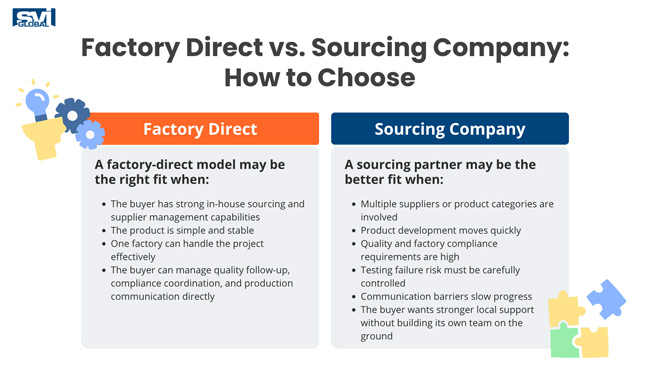
A factory-direct model may be the right fit when:
- The buyer has strong in-house sourcing and supplier management capabilities
- The product is simple and stable
- One factory can handle the project effectively
- The buyer can manage quality follow-up, compliance coordination, and production communication directly
A sourcing partner may be the better fit when:
- Multiple suppliers or product categories are involved
- Product development moves quickly
- Quality and factory compliance requirements are high
- Testing failure risk must be carefully controlled
- Communication barriers slow progress
- The buyer wants stronger local support without building its own team on the ground
In many cases, a hybrid model works best.
Some of the strongest sourcing structures combine direct manufacturing relationships where appropriate with sourcing partner support for supplier selection, coordination, QC follow-up, communication, and backup planning.
The best sourcing model is rarely ideological. It is designed around the actual needs of the buyer and the realities of the project.
Part 9. Key Questions Buyers Should Ask Before Choosing a Supplier
Instead of asking only whether a supplier is a factory or a trading company, buyers should ask more practical and more strategic questions.
- Who understands the product and the target market requirements?
- Who can identify the right-fit factory for the project?
- Who manages communication clearly and quickly?
- Who is accountable when issues arise?
- Who supports quality control and corrective action?
- Who helps protect lead times and delivery schedules?
- Who can provide alternatives if one supplier fails?
- Who helps reduce total sourcing risk, not just quoted cost?
These are the questions that lead to stronger sourcing decisions.
They move the conversation away from labels and toward execution, accountability, and business fit.
Conclusion
Factory direct sourcing can work well in the right situation. So can working with a sourcing company.
The better choice depends on the product, the order size, the compliance requirements, the need for supplier comparison, and the level of coordination required.
For global buyers, successful sourcing is not simply about removing intermediaries. It is about choosing the right sourcing structure for better quality, better control, and better long-term results.
At SVI, we have seen that buyers achieve stronger outcomes when they focus less on labels and more on fit, execution, and accountability.
In some projects, direct factory sourcing is the right answer. In others, a sourcing partner creates more value by saving time, reducing risk, and improving coordination.
The key is not to follow a fixed ideology. The key is to build a sourcing approach that works in the real world.