
7 Steps to Build an Effective Sourcing Strategy in Supply Chain

sourcing strategy

A sourcing strategy is essential when you choose to source products for your business in the global trade market. The benefits of having a well-built global sourcing strategy can protect your supply chain when things go sideways.

In the following parts, we will focus on what a sourcing strategy in supply chain is, explore the advantages and challenges, and, most significantly, show you how to build a strategy that will take your sourcing process to another level. Let’s get started!

Part 1. What Is a Sourcing Strategy?

A sourcing strategy is the approach that you use to identify and choose suppliers, and evaluate and re-evaluate the sourcing activities in the ongoing process.

It outlines how a company plans to procure products to maximize profits and optimize the supply chain with the lowest total cost of ownership and minimal supply chain risk.

Components of Sourcing Strategy in Supply Chain

The product sourcing strategy involves the whole process of sourcing goods. It determines whether your supply chain is resilient or fragile.

It outlines:

  • How do you select and qualify suppliers
  • What criteria matter most for your product category
  • How do you negotiate contracts and manage ongoing supplier relationships
  • How do you plan for supply chain risks and disruptions to ensure products arrive on time
  • How do you measure and improve sourcing performance over time

Objective of Sourcing Strategy

The essential goal of a supply chain sourcing strategy is to establish longstanding and strategic relationships with competitive suppliers. This is to obtain the optimal quality products within a specific cost while maintaining flexibility to adjust to market changes.

Part 2. Why Do You Need Sourcing Strategies in Supply Chain?

The global supply chain is changeable for businesses to dig for suppliers. A plan for sourcing before the wheel is in motion could direct you to the right path. The advantages of developing a sourcing strategy are:
sourcing strategy importance

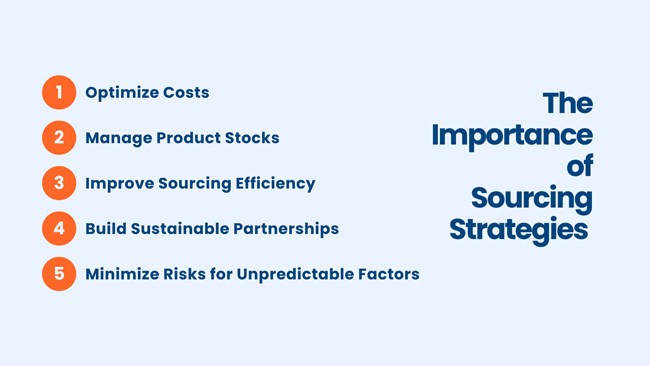
1) Optimize Costs

By aligning the goal of the plan, it can reduce redundant processes and vet the suitable supplier with efficiency. This helps get competitive product prices, reduce manufacturing costs and achieve better cost control.

2) Manage Product Stocks

Effective sourcing strategies ensure a steady flow of products, helping to maintain optimal stock levels. This reduces the risk of stockouts or overstocking, making better use of resources and minimizing inventory costs and capital.

3) Improve Sourcing Efficiency

A pellucid supplier sourcing strategy streamlines the process by building a standardized process with clear supplier criteria, product requirements and specifications, communication methods and lead times, which boosts overall operational efficiency.

4) Build Sustainable Partnerships with Suppliers

A defined engagement approach builds the kind of long-term partnerships that give you priority access, flexibility, and better terms over time.

5) Minimize Risks for Unpredictable Factors

Well-planned sourcing strategies ensure business continuity and reduce vulnerabilities to supply chain disruptions, such as natural disasters, geopolitical issues, or economic fluctuations, by diversifying suppliers and monitoring external risks.

Part 3. Types of Sourcing Strategies

A sourcing strategy involves two key decisions: where you source from and how you structure supplier relationships.

1) Geographic Sourcing Strategies

a. Global Sourcing (Offshore Sourcing)

Global sourcing means manufacturing outside your home country, usually in regions with lower costs or stronger manufacturing ecosystems such as China, Vietnam, India, or Mexico.

It is widely used by importers looking for cost efficiency, production scale, and specialized manufacturing capability.

Best for:  Companies looking to optimize cost while accessing manufacturing expertise unavailable domestically

Main challenges: Longer lead times, tariffs, logistics complexity, and stronger quality control requirements.

b. Nearshore Sourcing

Sourcing from manufacturers geographically closer to your end market, for example, Mexico for US firms, or Eastern Europe for EU companies, to reduce lead times and logistics complexity.

Best for: Categories where speed-to-market, lower freight costs, or tariff advantages outweigh the cost premium versus Asia-based manufacturing.

Main challenges: Higher unit costs and fewer supplier options compared with Asia.

c. Domestic Sourcing

Domestic sourcing means manufacturing within your own country. It offers easier communication, faster delivery, and lower geopolitical risk, but usually comes with significantly higher production costs.

Best for: Highly customized, low-volume, or locally branded products.

Main challenges: Higher labor costs and limited manufacturing capacity in some industries.

2) Supplier Relationship Structures

a. Single Sourcing Strategy

Intentionally consolidating a product category with one preferred supplier to maximize volume leverage, simplify supplier management, and build a deeper partnership.

Best for: Non-critical categories where the supplier has a strong performance history, or strategic categories where deep collaboration is the priority.

Main challenges: concentration risk, any disruption directly impacts your supply chain.

b. Dual Sourcing Strategy

Qualifying two suppliers for the same product or component, usually a primary and a secondary, to reduce dependency on a single source.

Best for: Critical products or categories with higher supply risk.

Main challenges: Management complexity, reduced pricing leverage, keep backup suppliers actively production-ready.

c. Multi-Sourcing

Working with 3 or more suppliers across different regions or factories. It increases flexibility, reduces concentration risk, and improves backup capacity.

Best for: Large-scale sourcing programs and multi-country supply chains.

Main challenge: More complex supplier and quality management.

Part 4. How to Develop a Supply Chain Sourcing Strategy?

Here’s a practical framework for developing a sourcing strategy from the ground up.
7 steps of sourcing strategy

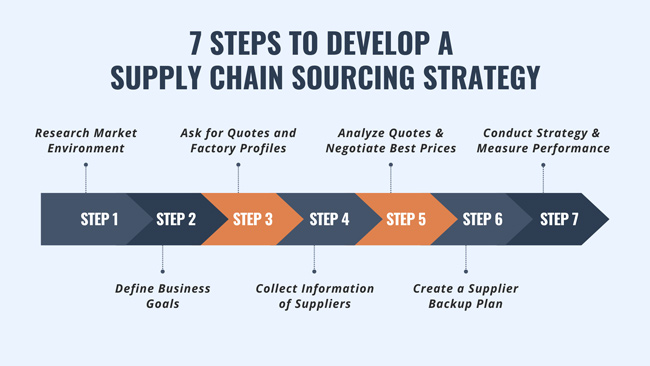
Step 1. Research Your Market and Manufacturing Landscape

▪ Conduct market research to analyze industry trends, competition, growth rates, and key manufacturing areas where products are concentrated.

▪ Gather data on typical pricing ranges and cost structures for your product.

▪ Identify relevant trade regulations, tariffs, and import requirements for your target markets.

▪ Document collected information and map key risks in your sourcing region.

Step 2. Define Business Goals & Requirements

▪ Based on research, define clear and measurable goals (e.g., cost reduction, quality improvement, or innovation) that align with your business objectives.

▪ Specify the product items, quantities, delivery time, compliance needs, etc.

▪ Set a budget based on market conditions and company priorities.

▪ Choose optimal regions to source products from by considering the potential U.S. tariffs on imports from China and other regions.

Step 3. Identify Factory Profiles

▪ Use industry directories, trade shows, and referrals to find suppliers.

▪ Issue a Request for Information (RFI) to gather basic capability data.

▪ Screen suppliers against your minimum criteria before investing in deeper evaluation

▪ Shortlist 3–5 suppliers per product category for further assessment.

Step 4. Collect Information of Suppliers

▪ Evaluate potential suppliers, including company type, financial stability, production capacity, quality control systems, product development, delivery times and on-time performance.

▪ Understand suppliers’ cost structure and pricing to gauge whether they offer competitive pricing and meet your budget expectations.

Step 5. Request Quotes and Negotiate the Best Prices

▪ Provide clear product specifications, quantities, and delivery deadlines.

▪ Review the received quotes with factory profile, factoring in not just FOB price, but quality control system, MOQ, lead time, payment terms, production capacity, product development capabilities and business experience in your market.

▪ Choose suppliers that offer the best value for costs by striking a balance between price and quality.

▪ Compare different quotes and negotiate to secure the best deal to identify any opportunities for cost reduction.

Step 6. Create a Supplier Backup Plan

▪ While selecting the best suppliers, identify alternative suppliers who can step in if the primary supplier faces issues such as production delays, quality concerns, or price increases.

▪ Keep backup suppliers warm, share forecasts, and place occasional orders to maintain the relationship

▪ Diversify geographically where possible to reduce concentration in a single region or country

Step 7. Conduct Strategy and Measure the Performance

▪ Execute your sourcing strategy and continuously monitor its effectiveness.

▪ Establish key performance indicators (KPIs) to measure program effect and supplier performance.

▪ Regularly review the performance against KPIs

▪ Share performance feedback proactively for improvement

▪ Revisit your sourcing strategy annually or when your business objectives change

This ongoing monitoring helps ensure that the sourcing strategy is aligned with business goals, and you can make adjustments as needed to optimize the process over time.
Part 5. Challenges of Creating a Global Sourcing Strategy

supply chain sourcing strategy challenges

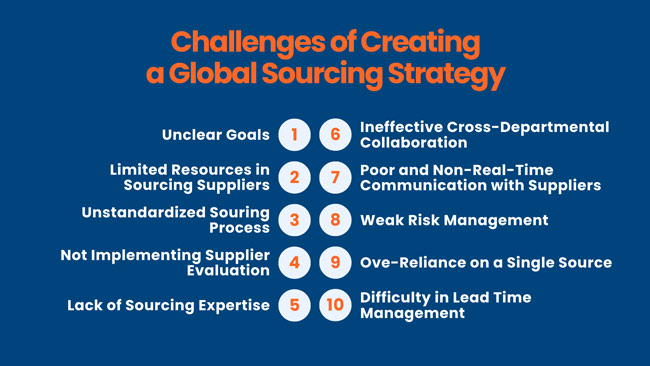
1) Unclear Goals

In the early stages, sourcing strategy goals are often based on experience. However, a lack of experience and info can lead to inaccurate budgeting, poor planning, and ultimately, vague or unclear objectives that hinder progress.

2) Limited Resources in Sourcing Suppliers

Companies, particularly smaller ones, often face resource constraints, including limited budget, or personnel. This makes it harder to dedicate the time and effort needed to search for the most suitable suppliers.

3) Unstandardized Souring Process

An unstandardized procurement process leads to inefficiencies, miscommunication, and errors across departments, resulting in delays and increased costs.

4) Not Implementing Supplier Evaluation

Without ongoing monitoring and evaluation, it’s hard to assess supplier performance, manage risks, or detect potential issues with quality, delivery, or compliance.

5) Lack of Sourcing Expertise

Procurement teams may lack expertise in areas like negotiation, global trade, or supplier management, which can result in poor decisions, excessive spending, or non-compliance.

6) Ineffective Cross-Departmental Collaboration

Misalignment between departments can result in procurement decisions that don’t fully consider other critical factors like budget constraints or technical requirements. This inefficiency leads to information opacity, missed opportunities and increased costs.

7) Poor and Non-Real-Time Communication with Suppliers

Language barriers and delays in communication are the difficulties in global sourcing. It probably gives rise to untimely information sharing regarding changes in demand, or specifications, eventually, affecting order fulfillment.

8) Weak Risk Management

Global sourcing involves plentiful risks that can negatively affect the business. Companies may not identify the hidden risks if you’re not equipped with timely info about variations in your sourcing process.

9) Over-Reliance on a Single Source

Relying on one supplier or region can expose a business to increased vulnerability to supply chain disruptions (e.g., supplier bankruptcy, and supply chain interruptions). Diversifying your supply chain should ease the impact.

10) Difficulty in Lead Time Management

The sourcing process is made of many lead times, such as product development lead time, manufacturing lead time, transportation lead time, etc. The supply chain is susceptible to disruptions. Therefore, it is easy to cause product delays if no measure.


Frequently Asked Questions about Supply Chain Sourcing Strategy

Q: How often should a sourcing strategy be reviewed?

It should be evaluated at least once per year. You might want to do it more often if your company is developing quickly, there are changes to the product line, or something important has changed in your sourcing area, such as a change in tariffs, geopolitical situation, or a big price change in raw materials.

Q: How do I start building a sourcing strategy if I have no experience?

First, determine what the requirements are for your product. Then, research the manufacturing regions specialized in your kind of products.

If you don’t have any field experience with those regions, working with a sourcing agent or supply chain partner who has established supplier relationships and local market knowledge can greatly reduce the time and risk involved in getting started.

Q: What external factors should I include in my sourcing strategy?

A variety of external factors not under your control may have a big effect on the whole sourcing process.

The shifting of the tariff and trade policy, raw material pricing, geopolitical risk, and global compliance requirements for products will be among those factors that need to be kept an eye on.

Q: What’s the main sourcing trend in 2026?

The sourcing strategy in 2026 is becoming more focused on risk reduction and supply chain resilience, not just cost savings. Many companies are adopting a China+1 strategy by keeping China as a core manufacturing base while expanding into countries like Vietnam, India, Indonesia, and Mexico to reduce tariff and geopolitical exposure.

Nearshoring also continues to grow, especially for North American buyers seeking shorter lead times and better inventory control. At the same time, ESG and compliance requirements are becoming stricter, pushing brands to improve supplier transparency and monitoring.

Another major trend is multi-country sourcing and stronger supplier evaluation, as importers pay closer attention to factory stability, quality systems, and long-term supply continuity.

Wrapping Up

Developing a well-defined sourcing strategy offers significant advantages that can transform your supply chain operations. Not only does it streamline the process and enhance efficiency, but it also helps control costs and ensure better supplier relationships. Although creating a successful strategy can encounter challenges, our guide on the 7 steps of sourcing strategy should lead the way.

Want to Find Manufacturers Easily?

If you’re struggling to find the right manufacturers or need expert assistance with sourcing, SVI Global is here to help. As a sourcing company connecting businesses with reliable OEM manufacturers, we place our office across key markets– China, Vietnam, Mexico, etc. Whatever aspect of the supply chain you need assistance with, we’ve got you covered. From sourcing and manufacturing to product development, quality control, and shipping management, our team handles it all. Once we receive your inquiry, we’ll get to work right away to meet your needs.

Table of contents

Related Blog
Get in Touch

Send us a message, we’ll get back to you within 24 business hours.

Get a Free Quote Now!

Send us a message, we’ll get back to you within 24 business hours.

Message

Reading Club

The goal of SVl Reading Club is to READ, THINK, and ENJOY. 

Club members will explore a shared classic book each session. Through individual reading, club discussions and sharing of reading inspirations, members will engage in meaningful and thoughtful exchanges of ideas. Cultivating a reading habit will help to promote cognition, enhance your knowledge, and foster flexible thinking.

reading club