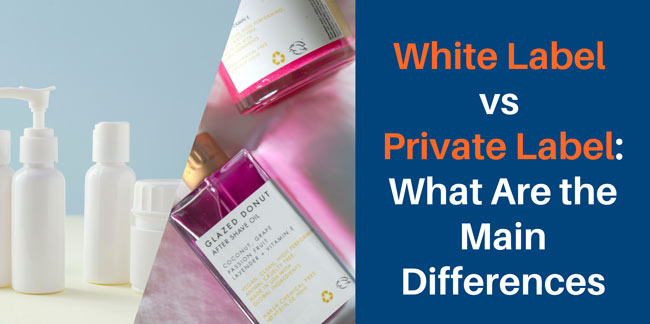
White Label vs Private Label: What Are the Main Differences
- Date:
- Author: SVI Content Team
- Share:
How to build your own brand in today’s market, driven by e-commerce, new retail and social commerce. As online traffic grows more fragmented and new sales channels expand rapidly, more businesses are looking for scalable ways to secure a position in the competitive market.
When exploring how to enter the market, you will often come across the terms white label vs private label. Both involve working with factories to produce products and selling them under your own brand. However, they follow different approaches, offer different levels of control, and are suited to different business goals.
In the following sections, we will break down private labeling vs white labeling by explaining their definitions, key differences, and pros and cons to help you choose the right one for your brand strategy.
Part 1. What Is White Label
1) Meaning of White Labeling
In supply chains, white-label products are manufactured by factories and sold by other companies under their own brand names.
Factories create their own product first. The specifications, materials, and structure are already fixed and developed in a standardized and non-branded way for most general products. Brands or retailers can simply select the existing items, add their brand logo and packaging, and then bring them to the market.
Simply put, factories have ready-mades and you just put a label on it and sell it.
Multiple brands can sell essentially the same product sourced from the same manufacturer, with minimal differences.
2) Key Features
Standardized, ready-made products: Products are pre-developed and mass-produced by the factory to meet general market demand.
Factory-owned intellectual property: Since manufacturers take the initiative to create products, the IP rights usually belong to them, not brands.
Non-exclusive supply: The same product can be supplied to multiple brands.
3) Pros & Cons of White Labeling
Pros:
- Rapid time to market
- Low and flexible minimum order quantity
- Lower unit price due to mass production
- Low initial investment with little to zero need in product development
- Stable and proven production lines
- Lower risk for trial orders or market testing
- Suitable for a wide range of customer groups
Cons:
- High product similarity with limited differentiation
- Overly competitive in prices, which squeezed profit margins
- Limited ability to build brand premium
- Weak long-term brand value
- Quality standards are controlled by factories, which may not align with different market requirements
4) White Label Product Examples
White labeling is commonly used for standard consumer goods with no special functional or design requirements. Typical examples include:
- Tissues and paper products
- Disposable cups and tableware
- Chargers and basic electronic accessories
- Household and daily-use items
These products do not require customization and can be sold quickly under different brand names.
Part 2. What Is Private Label
1) Meaning of Private Labeling
Private-label products are manufactured according to a brand’s specific and unique requirements and sold only under that brand’s name.
The buyer defines the product specifications, such as materials, structure, performance, design, and packaging, and appoints a manufacturer to produce strictly according to those requirements.
In short, you bring your own product specification, and the factory manufactures it for you. The product cannot be resold by the factory or supplied to other brands.
2) Key Features
Stronger product exclusivity: Products are developed based on your specifications and are sold only under your brand.
Brand-owned intellectual property: Even if the manufacturer is involved, the final formula or design belongs to you.
Buyer-led quality control: You have the final say on whether products pass quality inspections or not and can require specific certifications to comply with target market regulations.
3) Pros & Cons of Private Labeling
Pros:
- High differentiation and customization
- Greater pricing flexibility and higher profit margins
- Stronger brand value and long-term brand equity
- Complete control over quality standards and compliance
- Stronger buyer–manufacturer partnership for long-term business strategies
- Enables product innovation and continuous manufacturing improvement
Cons:
- Higher upfront investment in development, sampling, testing, packaging, and tooling
- Higher minimum order quantities (MOQs)
- Longer lead times compared to white-label products
- Higher concentration of risk if market response is weak
- Higher switching costs when changing manufacturers
4) Private Label Product Examples
Private labeling is commonly used for products that require clear differentiation, brand positioning, or performance customization. Typical examples include:
- Branded stationery and office supplies
- Personal care and cosmetic products
- Home and lifestyle products
- Functional consumer electronics and accessories
Part 3. Private Label vs White Label: Main Differences
To make things clearer, here are the key differences between white labeling vs private labeling, shown in a simple and easy-to-understand way.
| Dimension | White Label | Private Label |
|---|---|---|
| Product Control | Low, mainly controlled by the manufacturer | High, led by the brand owner |
| Customization | Very limited, usually logo and packaging | High, including materials, structure, function, and design, etc. |
| MOQ | Low, suitable for small batch orders | Large, usually requires scale production |
| Exclusivity | None, the same product can be sold to multiple brands | High, products are exclusive to one brand |
| Intellectual Property | Owned by the manufacturer | Owned by the brand |
| Cost & Entry Barrier | Low upfront cost and low entry barrier | Higher upfront investment and development costs |
| Time to Market | Fast, usually 1–2 months | Longer, usually 4–6 months or longer |
| Profit Margin | Low, price competition is intense | Higher, with greater pricing flexibility |
| Partnerships | Short-term, transaction-based | Long-term, strategic partnership |
| Quality Control | Based on manufacturer’s existing standards | Final quality approval controlled by the brand |
| Suitable Industries | Generic product categories, such as consumer goods and FMCG | Branded or differentiated products |
| Long-term Brand Value | Limited | High, supports sustainable brand growth |
| Supply Chain Risk | Lower | Higher |
Need Help for Your Sourcing Project?
Let SVI Global find the right suppliers and manage your project.
We guarantee quality and on-time delivery!
Part 4. When to Choose Private Label Products or White Label Products?
How to decide which is good for you? Below are the key factors to consider.
1) Budget & Resources
- Do you have sufficient start-up budget for development, sampling, and tooling?
- Do you have an internal team or external support to define your product specifications?
- How much inventory loss can you bear if the first batch of goods doesn’t sell well?
2) Time to Market & Replenishment Speed
- Do you need to launch quickly or restock fast to catch market demand?
- Which matters more to you: missing the traffic window or perfecting the product?
3) Pricing & Profit Margin
- Are you planning to compete mainly on price and volume?
- Do you need higher margins and pricing flexibility?
4) Customer/Channel Requirements
- Do you have stable sales channels?
- Which are your main sales channels, e-commerce platforms, your DTC sites, or retailers?
- Are customers sensitive to brand, design, or performance, or mainly to price and availability?
5) Product & Technical Requirements
- Is your product generic, or does it require technical differentiation or compliance?
- Are there mature, ready-made solutions already available in the market for the product you want?
- Do you have clear ideas or drafts about product functions, design, materials, or production processes?
- Do your products need certifications or safety tests to enter the target market?
6) Company Strategy & Long-term Goals
- Is your focus short-term speed and flexibility, or long-term brand building?
- Is your core competence marketing and distribution, or product development?
- Can you take the risk in exchange for higher long-term returns?
Overcome Challenges with SVI Global
Even after deciding on a white label or private label approach, companies find execution challenging in finding suppliers, managing communication and production, and other cases.
SVI Global, as your global sourcing company, can support you across the entire supply chain, from the start of discussing your requirements and locating the right manufacturer, to delivering finished products.
No worries about sourcing from overseas. Our end-to-end sourcing services include:
- Local vetted suppliers in major nearshoring and offshoring locations.
- Compare terms and choose the best supplier based on unit cost, tooling, logistics, and lead time.
- Apply consistent QC testing and inspections across regions.
- On-the-ground coordination to manage production and communication.
- Assist with freight planning, consolidation, and customs documentation.
- Multi-country sourcing enables you to shift or split production to reduce supply chain risk.
FAQ about Private Label & White Label
Q1. Is the pricing of private label products higher than that of white label products?
Yes. Private label products usually have a higher factory & selling price because their manufacturing cost includes product development and design. White label products are cheaper since factories have already developed and mass-produced them, spreading development costs across multiple buyers. Over time, however, private label products often deliver higher profit margins.
More: How to Calculate Total Manufacturing Costs.
Q2. Is white labeling legal?
Yes. White labeling is a legal and widely used way of cooperation across many industries. The key is to ensure the product complies with local regulations and that trademark usage, quality responsibility, and liability terms are clearly defined in the contract.
Q3. Is white label the same as private label?
No. Just like the difference between private and white label, as we mentioned earlier, White label products are standardized, ready-made items sold to multiple brands. Private label products are exclusive to your brand and customized based on your specific requirements that cannot be met by the existing products, even with minor changes. The main differences lie in customization level, exclusivity, cost, and production lead time.
Q4. Does a private label necessarily have to have its own factory?
No. Owning a factory requires significant investment in facilities, equipment, labor, and management. Most private label brands, whether startups or large firms, outsource manufacturing to third-party factories. Firms typically consider building their own factories only after reaching sufficient scale or seeking deeper control over quality and innovation.
Wrapping Up
White labeling and private labeling are not substitutes, but complementary models within a modern sourcing and branding ecosystem. Emerging companies often use white label products to enter the market quickly with lower risk, then transition to private label as demand grows and differentiation becomes critical. Likewise, large retailers may rely on private labels for core, high-margin products while sourcing non-core or standardized items through white label suppliers.
There is no one-size-fits-all answer when choosing between white label vs private label. The right choice depends on your business stage, budget, timeline, and goals.