Vietnam Product Sourcing: A Practical Guide from Real Experience
- Date:
- Author: SVI Content Team
- Share:
For many years, Vietnam has been recognized as one of the most promising and fast-growing manufacturing hubs in Asia. From indoor and outdoor furniture to home decoration, lifestyle accessories, and the ever-expanding pet product category, the country continues to attract global brands seeking quality, compliance, flexibility, and competitive pricing.
At SVI Global, our team handles communication with factories to guide clients through product development all the way to shipment. This guide is built on years of hands-on experience from our Senior Sourcing Specialist, Henry, in Vietnam.
It walks you through how Vietnam sourcing works in real life, and what buyers must do to avoid costly mistakes.
Why Vietnam Has Become a Global Manufacturing Powerhouse
Vietnam manufacturing has evolved significantly over the past decade. The shift from basic manufacturing toward value-added, design-driven production has created a strong environment for categories such as indoor furniture, outdoor furniture, home décor, and pet products.
1) Skilled craftsmanship and material knowledge
Across industries, local craftsmen possess deep experience in woodworking, weaving, and metalworking. This shows that factories understand not just how to produce, but why certain materials perform better in specific applications.
At the same time, many factories have invested in CNC machinery, kiln-drying systems, powder-coating technology, and computer-assisted design capabilities, thus enabling them to produce mass-market or customized items when needed.
2) Strong adaptation and flexibility
One of Vietnam’s defining advantages is its adaptability. Factories are very accommodating regarding adapting production lines according to new materials and unusual design notions.
For example, a textile factory producing cushions may swiftly pivot to manufacturing plush pet beds or quilted pet accessories, while furniture factories often explore new rope-weaving techniques or FSC-certified materials to meet client demands.
3) Competitive cost-to-quality ratio
While production costs have increased slightly in recent years, Vietnam still offers excellent value for brands seeking dependable quality without the high labor costs of some neighboring markets.
Because of these advantages, Vietnam emerges as a preferred destination for buyers who seek reliability, flexibility in minimum order quantity (MOQ), and a collaborative development environment.
4) Export-oriented infrastructure and trade integration
Vietnam’s manufacturing growth is also supported by practical advantages: a long coastline, modern ports, improving logistics networks, and participation in multiple free trade agreements.
These factors reduce export friction and make Vietnam easier to integrate into global sourcing strategies.
Step 1. Start by Understanding Client's True Needs
Real sourcing always begins with clarity before before factory visits or price discussions.
We spend time understanding the client’s true requirements. A solid project brief usually covers:
Before recommending any supplier, we take time to understand what the client is really trying to achieve. The essentials of a well-written project brief include:
- Market positioning (entry-level, mid-range, or premium)
- Expected durability, test standards, and certifications
- Preferred materials and construction details
- Budget constraints and target retail price
- Packaging format (KD packing, mail-order packing, retail display, etc.)
This step is critical because a well-defined project brief prevents unnecessary revisions later.
For example:
The construction of an outdoor dining set varies significantly depending on whether it is intended for a coastal market, where corrosion is a major factor, or for a dry climate, where UV resistance matters more.
Similarly, a $10 pet bed and a $50 pet bed may look similar at first glance, but they differ greatly in not just materials, but also design structure, foam density, washing performance, washability, and long-term shape retention.
A clear brief ensures we match buyers with the right type of factory.
Step 2. Find the Right Factory in Vietnam (Actual Screening Method We Use)
One of the most challenging steps in Vietnam product sourcing is factory selection. Vietnam has thousands of workshops and factories, but not all of them are suitable for every project.
Knowing how to find manufacturers requires both analytical and practical evaluation. In our Vietnam sourcing projects, we follow a structured process to filter and confirm suitable suppliers.
1) Capability and specialization check
First of all, we need to understand what a factory truly does. There are numerous process technologies included in making a product. Manufacturers within the same product category may seem similar on paper, but in reality, their core strengths and skills can be quite different.
Take furniture sourcing in Vietnam as an example, not every furniture factory can produce all furniture categories.
- A Vietnam supplier skilled in MDF and veneer might struggle with solid acacia joinery.
- A weaving specialist may not have strong metal-frame welding capabilities.
Matching specialization to product requirements is essential.
2) Compliance, testing, and certifications
Compliance is a non-negotiable part of Vietnam sourcing, especially for buyers selling into different channels.
Depending on client needs, we verify certifications such as FSC, BSCI, ISO9001, OEKO-TEX, and specific testing for chemical safety, weight capacity, moisture control, or UV resistance, based on the products and target markets.
Major retail chains often have strict compliance criteria, and failing to meet them can result in costly rework or production delays.
3) Operational stability and real reputation
Some Vietnam factories communicate very well but struggle with quality consistency. Others produce excellent craftsmanship but lack the systems to manage complex or high-mixed production. Practical on-site factory evaluations reveal the true capability behind the showroom. It ensures you:
- Production flow and capacity
- Regulatory and production safety
- Quality control processes
- Working environment and labor management structure
- Problem-solving ability
A strong supplier is not necessarily the cheapest, but the one who consistently delivers good quality, meets deadlines, and communicates transparently.
Step 3. Develop Product Concepts into Market-Ready Prototypes
Once a suitable supplier is selected, the development phase begins.
Based on our experience, this stage is often the most creative yet challenging. It requires close coordination between clients, engineers, and factory technicians.
1) Translate concepts into technical construction
Not every client comes with a complete technical package when they source products from Vietnam. Some share only reference photos, mood boards or basic sketches.
To get an accurate quote from supplier, our role is to interpret into clear, workable specifications and guide manufacturers on structure, materials, and finishing. Take our experience on furniture and pet products sourcing as an instance:
For indoor furniture, this may involve:
- Determining wood joinery to ensure durability
- Choosing the right finishing coat (PU, NC, water-based)
- Ensuring drawer or door mechanisms function smoothly
For pet products, key considerations include:
- Fabric durability and washability
- Safety (no small detachable parts)
- Comfort, ergonomic shape, and breathable fillings
2) Manage sampling and revision loops
Sampling is rarely a one-time process. Most products go through 1–3 iterations before approval.
For industries in furniture, home decor & pet:
- A rope-woven chair may need tighter weaving.
- A pet bed may require better edge stitching.
- A lamp or decorative item may need weight adjustments for stability.
We need to manage communication between the client and factory, so the final sample meets both expectations and technical standards.
3) Cost engineering without compromising quality
Cost optimization is a common request in Vietnam product sourcing. And the challenge is to balance savings without sacrificing performance.
The initial technical package or design might only be based on visual ideas rather than the actual application of materials.
However, for some products, changing the fabric grade, adjusting the size, or modifying the packaging can significantly reduce costs.
Step 4. Conduct Inspections to Ensure Quality Success
Consistent quality is the backbone of long-term cooperation on how to find factories in Vietnam successfully. A structured QC process should not be a last-minute check.
1) Pre-production inspection
We need to verify materials, color swatches, hardware, packaging samples, moisture levels in wood, and construction details before mass production begins.
2) In-line quality checks
During the product manufacturing process, we also monitor and inspect the products.
Quality checks during early production can identify defects, such as uneven weaving, incorrect drilling or fabric cutting errors. This can prevent waste and delays in large-scale production.
3) Final Random Inspection (FRI)
Using AQL standards, we should go through workmanship, safety, function, assembly, labeling, and packaging.
Any defects need to be documented with clear photos and corrective action instructions.
This structured QC system has prevented many potential shipment issues, safeguarding product reliability and protecting the client’s brand reputation.
Step 5. Maintain Smooth and Efficient Communication
For buyers learning how to find Vietnam manufacturers, communication is often underestimated, yet it underpins the success of nearly every sourcing Vietnam project.
When issues like unexpected delays or specification changes for retail compliance happen, proactive communication is what keeps projects on track.
In our experience:
- Frequent updates minimize uncertainty
- Visual documentation helps avoid misunderstanding
- Clear explanations reduce production mistakes
- Transparency builds trust on both sides
Real Lessons from Sourcing in Vietnam
Assisting buyers in sourcing products in Vietnam lets us learn the best practices for maintaining a successful project.
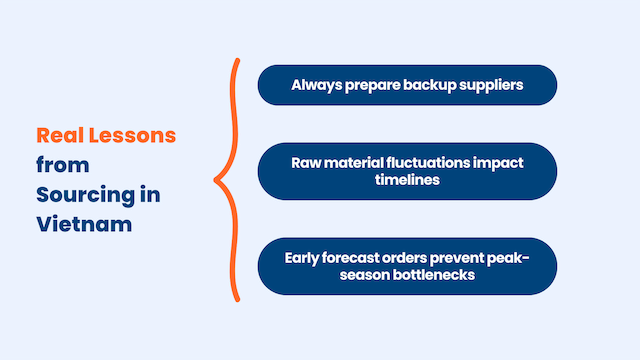
1) Always prepare backup suppliers
That’s also one of the strategies to diversify your supply chain network.
During peak seasons, factories often face worker shortages or full capacity. A backup factory ensures continuity and helps meet tight deadlines without starting from zero.
What to do:
- Pre-approve at least one secondary supplier for each key category.
- Make sure your backup has passed basic capability and quality checks.
- Keep them updated with your forecasts, even if they’re not producing yet.
2) Raw material fluctuations impact timelines
The supply chain is sensitive to raw material fluctuation. Wood, metal, and fabric prices can change rapidly.
Staying informed helps clients budget correctly and avoid last-minute surprises.
What to do:
- Ask suppliers for monthly updates on core material costs.
- Build a buffer into your budgets.
- Confirm whether quotes are valid for 30, 60, or 90 days.
3) Early forecast orders prevent peak-season bottlenecks
Factories in Vietnam appreciate clients who plan ahead. The sooner they know your production window, the better they can reserve workers, materials for production.
What to do:
- Share rough forecasts even before confirming POs.
- Book production slots 1–3 months early.
- For seasonal products, confirm orders before peak periods (usually July–November).
4) Case Example: Why Preparation Pays Off
Our one project involved an outdoor furniture set with a hard retail launch date. Midway through production, the main factory faced a sudden labor shortage.
Because we had already vetted a secondary supplier, we shifted part of the production immediately, no redesigns, no repeat sampling, no lost time.
Eventually, production stayed on track, and the client launched the collection as planned.

Why Clients Trust SVI for Sourcing in Vietnam
Vietnam’s manufacturing potential is immense, but navigating it requires experience, relationships, and on-the-ground insight. At SVI Global, we help brands turn Vietnam sourcing into a controlled, transparent, and reliable process. We offer:
- Reliable supplier networks built over years
- Transparent processes with clear reporting
- Technical expertise across multiple product categories
- Strong QC support from sampling to shipment
- Problem-solving mindsets that protect client timelines
Whether you’re new to Vietnam or expanding existing categories, think of this guide as a roadmap.
If you need help bridging the gap between your ideas and the factory floor, our team is always ready to support your next project.