During Production Inspection: What Is It & Best Practices
- Date:
- Author: SVI Content Team
- Share:
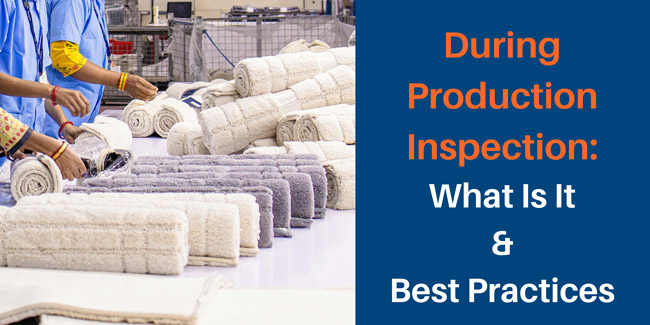
Quality control is not a one-off thing. After an initial production inspection confirms that production has started correctly, manufacturers still need to maintain the same standards throughout the production process. Waiting until the final inspection to identify problems is risky, as defects may have already affected a large portion of the order, which could lead to extra costs and delayed delivery.
A during production inspection helps prevent these issues by evaluating product quality while manufacturing is still underway. Conducted when production reaches a certain stage, you can learn whether the factory is following approved specifications, identify quality issues early, and give suppliers time to take corrective action before production is completed.
In this guide, you’ll learn what a during production inspection is, what it checks, when it should be performed to reduce defects and production risks.
Part 1. What Is During Production Inspection (DUPRO)
A During Production Inspection is a quality control inspection conducted while manufacturing is in progress, when 20 – 80% of the order is complete.
The goal is to identify defects, process inconsistencies, material deviations, or compliance issues early enough for corrective action before production is finished.
Unlike a pre shipment inspection (PSI), which evaluates finished goods at the very end of the manufacturing run, DUPRO focuses on monitoring quality while goods are still being produced.
As production scales up, conditions change, quality can drift in ways that aren’t visible until a pre-shipment inspection confirms the damage, at which point 100% of production is complete and your options are expensive and limited.
Part 2. Why Do You Need During Production Inspection
By the time a PSI is conducted, every unit has been produced and packed. If quality drifted during production, the PSI confirms the problem after there’s nothing left to correct within the production window.
DUPRO exists for the risks that develop in the middle of a production run to catch the ones that weren’t present at the IPI and won’t be catchable at PSI without high cost.
1) Production Conditions Change
As manufacturing progresses, raw material batches may change, machines gradually wear, operators rotate between production lines, and production speed often increases to meet deadlines.
These changes can lead to variations that were not present during the initial production inspection. A DUPRO is able to verify whether the product quality remains consistent despite these changes.
2) Verify Corrective Actions & Catch Recurring Defects
When an IPI identifies a problem and the factory commits to a fix, someone needs to confirm that the fix was actually implemented and maintained across the rest of the production run, not just on the re-inspected units.
If the same issue is recurring, it surfaces here rather than at pre-shipment, when the entire order has already been affected. The earlier a defect pattern is identified, the more of the remaining production can still be corrected.
3) Verify Production Progress Can Be Verified
In-line production inspection is not only a quality inspection but also a progress review. Inspectors evaluate whether production is advancing according to schedule, whether capacity is sufficient, and whether the factory is likely to complete the order on time.
This gives buyers early visibility into potential delivery risks instead of discovering delays just before shipment.
4) Pre-holiday Production Pressure
In the weeks before major shutdowns, factories face intense schedule pressure. To meet shipping deadlines, production speed increases, temporary workers are brought in, and internal quality checks are often shortened or skipped.
This creates elevated risk for process defects and quality inconsistency in the later stages of a production run. Scheduling a DUPRO during high-pressure production periods provides the oversight that factories are less likely to apply themselves when output targets dominate.
5) Objective Evidence for Future Claims
A DUPRO report also serves as valuable commercial evidence. It documents production conditions, inspection results, photographs, and corrective actions while manufacturing is still in progress. If quality disputes arise after delivery, this documentation helps buyers demonstrate when defects were identified, what actions were requested, and whether the supplier fulfilled its obligations—providing stronger support during negotiations, warranty claims, or trade disputes.
Benefits of During Production Inspection
The advantages we can conclude from the conditions are:
- Catch problems early, before defects spread to the full order.
- Fix issues while there is still time to correct the process or materials.
- Reduce waste, rework, returns, and replacement costs.
- Improve schedule control by spotting delays or manufacturing risks
- Check consistency in workmanship, color, labeling, dimensions, and packing.
- Help the buyer and factory communicate better while production is still active.
- Reduce the chance of customer complaints and protect brand reputation.
- Documented evidence for dispute resolution
Need Help for Your Sourcing Project?
Let SVI Global find the right suppliers and manage your project.
We guarantee quality and on-time delivery!
Part 3. What Is Included in a During Production Inspection?
During the in process inspection, samples are selected randomly using ISO 2859-1 (ANSI/ASQ Z1.4) statistical sampling standards to provide an objective assessment of the production run. It usually includes what to check:
1) In-production unit inspection
Finished units from the production line will be checked against approved specifications. This will involve verifying such characteristics as dimensions, appearance, workmanship, functionality, labels, and other product-specific requirements. This is to confirm that products currently being manufactured remain consistent with the approved sample.
2) Production consistency monitoring
Unlike an Initial Production Inspection, DUPRO evaluates whether quality has remained stable as production progresses. You should look for any detectable production drift caused by equipment wear, or new raw material batches, ensuring consistency across the production run rather than only the first units.
3) Corrective action verification
If problems were identified during the Initial Production Inspection (IPI), it is a good time in DUPRO to verify that corrective actions have been fully implemented. The focus is not only on whether defective products were fixed, but whether the improvements have become part of the normal production process.
4) Packaging and compliance
Package is also inspected prior to completing the manufacturing process. The packaging material, carton marking, shipping label, bar code, and regulatory information need to be in line with the purchase order and the market requirements. Early detection of package issues prevents additional repackaging before shipment.
5) Production schedule assessment
Besides product quality, the other factor assessed by DUPRO is whether the production is on track with the scheduled plan. Consider the completion rate, remaining production capacity, material availability, and any bottleneck that might hinder shipment. This will be the point at which early warnings can be detected.
Part 4. Best Practices for During Production Inspection
These practices help you get accurate results and maximize the value of mid-production oversight.
1) Schedule at the right production stage. The 30–50% completion window gives enough units for representative sampling while leaving sufficient time for corrective action before the shipment deadline.
2) Use independent third-party inspectors. Factory self-inspection under deadline pressure is not a reliable substitute for independent verification. An inspector with no stake in the outcome provides the objectivity that makes findings credible and defensible.
3) Connect DUPRO with earlier findings. Share the IPI report with the DUPRO inspector before the inspection so that corrective action verification is built into the scope. It allows checking whether the issues were corrected in the whole production line.
4) Require written corrective action responses within a defined timeframe. Verbal commitments to fix problems are unverifiable. Ask the supplier to provide a written root cause analysis and corrective action plan with clear responsibilities and completion deadlines. This helps prevent the same problems from recurring in later production.
5) Don’t continue production blindly when serious deviations are found. If a DUPRO identifies a critical defect or a systematic process failure, halt the affected production until the root cause is confirmed and corrected. Proceeding without correction could result in larger losses and more rework.
6) Make DUPRO part of high-risk orders. For new suppliers, complex products, large-volume orders, or products with strict compliance requirements, include During Production Inspection as a standard milestone in your quality plan. This is more effective when factories know an in-process inspection is scheduled,
7) Benefit from the DUPRO report in case of disputes. A documented inspection report shows defect rates, process deviations, or corrective action requests. It gives you concrete evidence when reviewing supplier performance, negotiating prices, or solving other issues.
8) Pull samples during DUPRO for laboratory testing. Where the product requires destructive or performance testing, the DUPRO visit is an efficient opportunity to pull production samples and send them for testing, rather than waiting until goods are finished and packed.
Conclusion
A During Production Inspection (DUPRO) verifies that production remains stable and consistent by randomly inspecting semi-finished and finished products during manufacturing. Detecting problems in the middle of production is very different from finding them at the end—the issue may be the same, but your options to correct it are far greater.
For new suppliers, large orders, or long production cycles, DUPRO turns quality control from reactive to proactive. At SVI Global, our on-site quality team is able to monitor production, verify corrective actions, and provide objective inspection reports to help importers maintain consistent quality and reduce sourcing risks before shipment.
Start streamlining your sourcing process
We help you to build reliable supply chains across China and SEA.