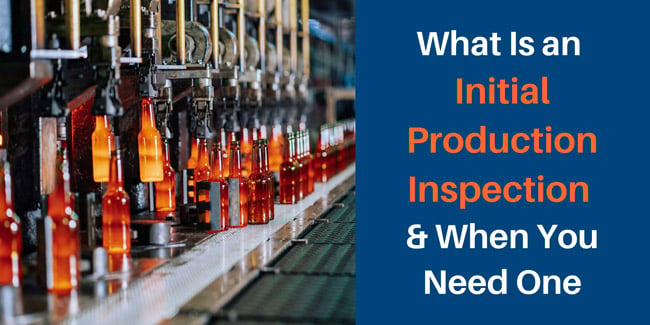
What Is an Initial Production Inspection & When You Need One
- Date:
- Author: SVI Content Team
- Share:
When you cooperate with a new supplier, one of the biggest concerns is whether the approved sample can be consistently reproduced in mass production. Even if the pre-production sample meets your requirements, it does not guarantee that the first products coming off the production line will meet the same standard.
Quality control is a continuous process, and an initial production inspection is one of the checkpoints after production begins for risk control.
Unlike a pre-production inspection that focuses on production readiness before manufacturing starts, an initial production inspection evaluates the first production batch to verify that the factory is following the approved specifications.
It helps identify problems early, verify first-article consistency, and establish clear quality expectations between you and your supplier.
You probably have some ideas on what an initial production inspection is, how it works, and when to conduct it. Now, let us move to the next step.
Part 1. What Is an Initial Production Inspection
| Inspection Type | Timing | What Is Inspected | Purpose |
|---|---|---|---|
| Initial Production Inspection (IPI) | 0–20% of production complete | First units off the actual production line | Verify mass production meets spec |
Part 2. Why It is Necessary to Conduct an Initial Production Check
An Initial production check is a risk control measure designed to identify and correct production issues while they are still manageable.
By detecting problems at the beginning of mass production, you will be able to prevent defects from being repeated across the entire order and reduce the cost of corrective actions.
An IPI helps verify that:
- Production conditions are ready for mass manufacturing: Confirm that production lines, equipment, tooling, molds, and processes are properly set up and operating consistently.
- Materials and components match approved requirements: Make sure that suppliers are using the approved materials and parts rather than making substitutions during mass production.
- Supplier understands product requirements: Identify any gaps in the supplier’s interpretation of product requirements, drawings, or quality standards before large-scale production continues.
- Approved quality standards are established in practice: Select and confirm acceptable production units as physical references for future inspections and quality checks.
This is especially important for new products or new suppliers.
Without an IPI, quality issues may remain unnoticed until a mid-production or final inspection. If defects are found beyond the acceptable AQL limits at that stage, you may face difficult decisions: rework the entire batch, scrap defective products, or accept quality issues and absorb the associated costs.
The purpose of an Initial Production Inspection is to use a small early-stage inspection investment to prevent much larger costs later. This is why many global brands and retailers include IPI as a required quality control checkpoint in their manufacturing process.
Part 3. When Should You Schedule an Initial Production Inspection
An Initial Production Inspection should be scheduled after the production line has been fully set up. In most cases, the ideal timing is when approximately 0 – 20% of the order has been completed, because it provides a representative production batch while leaving sufficient time to correct any issues before full-scale manufacturing continues.
Involve an IPI when:
- Launching a new product or starting mass production for the first time
- Working with a new supplier that has not yet demonstrated consistent quality performance
- Manufacturing complex products with tight tolerances, multiple components, or demanding quality requirements
- Using new materials, special finishes, or specialized production processes
- The supplier has a poor quality track record with critical quality issues or specification deviations
- Production takes place during peak seasons like before Chinese New Year, when factories are under greater production pressure
- Production resumes after a long shutdown or significant process change
- The product belongs to a high-risk category, such as toys, baby products, electrical and electronic products, or automotive components
Apply flexibly when:
- You have an established supplier with a proven quality record.
- The product is simple and specifications remain unchanged.
- The order is a repeat production run using the same materials and manufacturing process.
An Initial Production Inspection may provide limited value for very small orders where the inspection cost outweighs the potential quality risk.
It is also less necessary for standardized commodities or raw materials that require little or no manufacturing process, as there are fewer production variables that could introduce defects.
In these situations, a pre-shipment inspection or incoming material verification is often a more cost-effective quality control approach.
Part 4. What Does an Initial Production Check Include
During an Initial Production Inspection, inspectors will randomly select samples from the first production batch and compare them against approved specifications, reference samples, and any buyer-specific requirements.
The inspection includes the following areas:
1) Raw Materials and Components: Verify that the manufacturer use only approved materials and components, with no unauthorized substitutions. Material batches and storage conditions are also checked to ensure consistency throughout production.
2) Production Setup and Equipment: Confirm that production lines, machinery, tooling, and molds have been correctly installed, calibrated, and are operating within the required process parameters.
3) Manufacturing Process: Assess the compliance of production procedures and identify any issues that could affect product quality, efficiency, or delivery schedules.
4) Product Quality: Inspect the first production units for workmanship, dimensions, appearance, functionality, and other product-specific requirements to verify compliance with approved specifications.
5) Packaging and Labeling: Verify that packaging materials, product labels, and markings meet your requirements and applicable regulatory standards.
All inspection findings, including conforming and non-conforming items, and photographic evidence, will be documented in an inspection report for future reference and to take necessary steps to correct the issues.
How Initial Production Inspection Fits into Quality Control Process
An Initial product inspection is only one checkpoint in a complete quality control program. Each inspection is conducted at a different stage of production and serves a different purpose.
| Timing | Inspections | Purpose |
|---|---|---|
| Before production | Sample Approval | Verify product design and manufacturability before production |
| 0-20% complete | Initial Production Inspection | Verify production setup and first production output |
| 20-80% complete | During Production Inspection / In-line Inspection | Monitor ongoing quality and confirm corrective actions are holding |
| 80-100% complete | Pre-Shipment Inspection / Final Inspection | Verify finished goods before cargoes leave the factory |
| After production | Container Loading Check | Confirm correct loading quantities and shipment conditions |
One Inspection Is Not Enough
Each inspection addresses a different type of risk.
An Initial Production Inspection confirms that production starts correctly, but it cannot guarantee that quality remains the same throughout manufacturing.
Likewise, a Pre-Shipment Inspection identifies product defects before shipment, but by then, it is costly and time-sensitive to take corrective actions.
A complete quality control plan should integrate multiple inspection stages to create end-to-end visibility. The right combination depends on the supplier relationship, product complexity, and order volume, but the principle holds across all of them: continuous oversight reduces manufacturing risk more effectively than any single inspection point.
Common Mistakes in Initial Production Inspections
1) Scheduling IPI too late
Some treat “initial production inspection” as meaning the first inspection on the order, and conducting one at 40 – 50% completion. This has reduced its value, as defects may have already spread across the batch.
2) Skipping IPI for new suppliers or products
The first production run with a new supplier is when quality expectations are being set. Without early verification, misunderstandings about specifications, materials, or processes can become costly quality issues.
3) Not providing a clear inspection checklist
Where there are specific check conditions for any product, they need to be specified at the very outset, and the detailed checklist and reference samples must be provided. Otherwise, only general standards are applied in the inspection, which may lead to an insufficient quality report.
4) Relying on the factory’s own inspection
An IPI conducted by the factory’s internal QC team is not equivalent to an independent third-party inspection. An independent product check provides an objective quality outcome.
5) Taking a pass as a final guarantee
A passing IPI means the first units meet specifications. It does not guarantee the entire batch will. Factors like production conditions, material batches, machine performance can shift over the course of a run. For large or high-value orders, it is required to involve follow-up inspections for maintaining visibility.
Conclusion
As the earliest point in the manufacturing process, an Initial Production Inspection provides an opportunity to identify defects under real production conditions and correct issues before they scale.
IPI is not required for every production run, but it is a highly valuable risk control measure for new supplier relationships, new products, and large-volume orders, where early mistakes can lead to significant rework costs and production delays. However, it should not replace other quality checks. To maintain product consistency from production start to final delivery, a complete quality control strategy combines inspections throughout different production stages.
Managing manufacturing quality requires controlling the entire production process, including timelines, supplier coordination, and corrective actions. For many buyers, managing these steps across overseas suppliers can be challenging.
SVI Global supports businesses throughout the manufacturing journey with supplier coordination, production management, and quality control services, helping ensure projects move forward more predictably and efficiently.