How to Prevent Your Products from Shipping Damage
- Date:
- Author: SVI Content Team
- Share:
Shipping damage is one of the most common risks in international trade. Some industry sources claim that around 10% of packages or shipments arrive damaged. In international freight, damaged shipments can lead to product losses, delayed deliveries, and unexpected costs.
When the goods get crushed or damaged, not being in the same state as they left the factory, why did that happen? Whose responsibility is it?
In this guide, you will learn the common causes of damage to cargoes, how to determine liability, the steps of receiving shipments, and tips to take to reduce the risk of cargo damage in international shipping.
While this may be viewed as a logistical issue, the root cause frequently lies in packaging design, material handling protocols, or storage methods, long before transportation is even in the picture.
Part 1. What Is Cargo Damage & Why Does It Happen
Cargo damage is any physical deterioration, loss, or destruction of goods that occurs from the time it is shipped to its destination of arrival.
1️⃣ Types of Shipping Damage
1) Physical impact damage: This includes crushing, denting, breakage, deformation, scratches, and torn packaging caused by drops, collisions, rough handling, improper stacking, or cargo shifting during transport.
2) Wet & moisture damage: Goods may become wet, moldy, rusted, warped, or spoiled due to rain exposure, container leaks, seawater ingress, or condensation.
3) Contamination: Cargo can be damaged by dust, dirt, chemical exposure, odors, pests, or residue left from previous shipments.
4) Reefer failure: Temperature-controlled shipments compromised by equipment malfunction or incorrect settings.
5) Theft or tampering: Goods missing or packaging showing signs of forced entry.
2️⃣ Common Causes of Cargo Damage
Although the reasons for damage to shipping are numerous, most shipping damage stems from preventable issues. Here are:
1) Poor Packaging: Insufficient cushioning, weak cartons, inadequate palletization, or excessive empty space inside boxes that allows goods to shift.
2) Improper Loading & Handling: Rough handling, dropping cargo, forklift damage, or incorrect loading procedures.
3) Incorrect Stowage: Poor stacking, uneven weight distribution, overloading, or cargo extending beyond pallet edges.
4) Unsuitable Storage Conditions: Dirty containers, excessive humidity, inadequate ventilation, or incorrect temperature control.
5) Improper Storage after Loading: Failure to manage temperature, humidity, ventilation, or cargo securing during transportation.
6) Severe Weather & Natural Calamities: Storms, typhoons, floods, or other extreme weather events.
7) Transportation Accidents: Vessel collisions, truck accidents, fires, explosions, or other logistics incidents.
8) Theft & Pilferage: Cargo stolen during storage, transit, or port handling.
9) Other Unidentified Causes: Damage that cannot be clearly attributed to a specific source.
Part 2. How to Protect Packages from Damage
The best way to prevent shipping damage is to control quality before risk transfers and stay protected after it does.
Way 1: Specify Packaging Standards in Your Purchase Order
Clearly write down your requirements and suggestions for product packaging in your order. The more detailed it is, the better:
- Outer carton specifications: material grade, wall thickness (single or double wall for heavy goods), and maximum weight per carton
- Inner protection: cushioning materials, foam inserts, dividers, and void fill requirements to prevent movement inside the box
- Pallet specifications: dimensions, weight limits, stacking pattern, and strapping or stretch wrap requirements
- Labelling rules: fragile markings, “this side up,” SKU and barcode placement
- Testing standards: drop test or transit test requirements for fragile or high-value products where applicable
Way 2: Make Packaging Part of Pre-Shipment Inspection
Conduct the final inspection on site by checking the packaging condition before goods are loaded. If issues are found during the inspection, you can take more measures to secure the cargo.
- Verify carton count and confirm quantities match the purchase order
- Check that cartons show no crushing, tears, or damage
- Check that pallets have no tilting, gaps, or overhanging cargo
- Confirm strapping and stretch wrap are applied correctly
- Check that moisture protection (desiccants, barrier bags) is in place where required
Way 3: Purchase Your Own Cargo Insurance
Regardless of whether the seller arranges insurance, you should consider securing your own coverage once the shipment risk transfers to you.
Under CIF terms, sellers are only required to provide minimum coverage under Institute Cargo Clauses (C), which covers a limited range of major risks and excludes many common damage scenarios, including breakage, leakage, and improper handling. Before relying on any policy, verify what risks are covered and excluded, the geographic scope, the insurance period, and the compensation limits.
If goods are lost or damaged outside the policy period or outside its coverage scope, you are unprotected.
For broader protection, you can choose to purchase Institute Cargo Clauses (A) for every shipment, covering invoice value plus 10%.
Way 4: Match Shipping Method to Product Fragility
Select the appropriate container and transportation method based on the product’s fragility, value, shipping timeline, and budget.
- For time-sensitive, fragile, or high-value goods, air freight is a better option as it offers shorter transit times and fewer handling touchpoints to reduce damage risk.
- For larger, non-fragile cargo, FCL (Full Container Load) is more stable to balance the time and budget. Goods are loaded once and sealed, which minimizes the re-packing risk and handling exposure.
- For non-fragile products with low volume, LCL (Less than Container Load) is suitable as it has the lowest freight. But it involves more consolidation and deconsolidation activities that can increase the likelihood of goods damage.
Way 5: Know Your Bill of Lading
The Bill of Lading (B/L) is one of the most important documents in any cargo damage claim.
Before shipment:
- Confirm the B/L accurately describes the goods, quantities, and packaging
- Verify the consignee, notify party, and shipping terms are correct
- Ensure carton counts and weights match the purchase order
- Confirm the stated Incoterms align with the sales contract (FOB, CIF, DDP, etc.)
At delivery:
- Inspect the cargo before signing any delivery documents
- Record visible damage, shortages, or packaging issues immediately
- Never sign a clean delivery receipt if damage is suspected
Part 3. Who Is Responsible for Shipping Damage?
In international freight, cargo damage liability depends on where the damage occurred, what caused it, and the Incoterms agreed between you and the supplier.
How Incoterms Determine Liability
Incoterms define the exact point at which risk transfers from seller to buyer. That transfer point is what determines who is responsible.
| Incoterms | Risk Transfers At | Who Bears Transit Damage Risk | Insurance Obligation |
|---|---|---|---|
| EXW | Factory/warehouse | Buyer from point of collection | Buyer arranges |
| FOB | Loaded onto vessel at origin port | Buyer once on board | Buyer arranges |
| CFR | Loaded onto vessel at origin port | Buyer once on board | Buyer arranges |
| CIF | Loaded onto vessel at origin port | Buyer bears risk | Seller arranges minimum cover |
| DDP | Delivered to named destination | Seller until delivery | Seller arranges |
Note: Under CIF, the seller covers freight and provides basic insurance to the destination port, but risk still transfers at the point of loading.
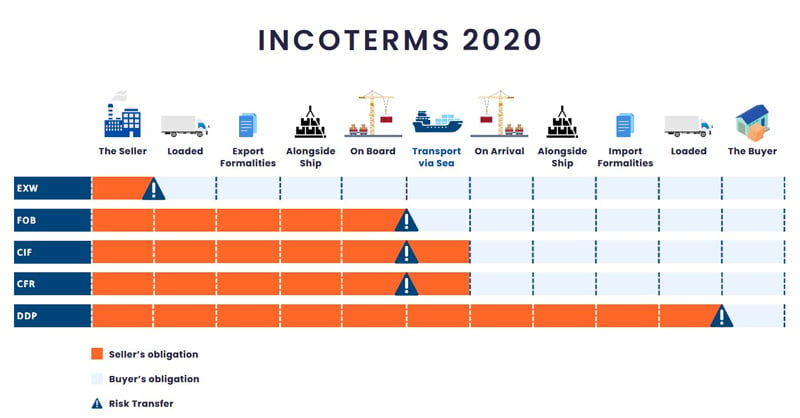
Although Incoterms determine when risk transfers, they do not automatically determine who caused the damage. Depending on the circumstances, responsibility may fall on the supplier, carrier, freight forwarder, or insurance provider.
– The supplier is responsible for damage before loading or goods are delivered to the carrier.
– The carrier is held accountable in case damage happens during transportation.
– The freight forwarder is responsible for damage resulting from poor shipping arrangements, incorrect shipping information, or failure to follow instructions. Otherwise, the actual carrier is the one who should be blamed.
– If cargo insurance is in place, you can file a claim for covered losses that occur during the insured transit period.

Part 4. What to Do Immediately When Damaged Cargo Arrives
Step 1: Inspect Before You Sign
The first thing that you have to do is to check for any signs of damage before signing anything.
If visible damage is present, record it directly on the Bill of Lading (B/L) or Delivery Receipt before signing.
Wherever it is not possible to do a complete examination of the shipment, you can put a notice on it that the goods will be checked.
In cases where the cargo is severely damaged and unusable, you may refuse delivery, but the reason should be clearly documented.
Step 2: Document Everything Immediately
Before moving, unpacking, or disposing of anything, thoroughly document the condition of the shipment.
Take pictures of damaged cartons, pallets, packaging materials, and products from multiple angles. Capture shipping labels, seal numbers, container markings, and any other identifying information. Timestamps will help establish when you discovered the damage.
Step 3: Preserve All Damaged Goods and Packaging
Keep all damaged goods and packaging materials until the claim has been fully resolved.
You may be asked by carriers or insurance companies to inspect the shipment before giving the green light for compensation.
Step 4: Notify All Relevant Parties in Writing
Inform in writing the carrier, cargo insurer, and supplier as soon as the damage is discovered.
Written communication creates a record of when the issue was reported and helps demonstrate that you acted promptly. Be sure to keep copies of all correspondence, including emails, claim forms, and responses.
Step 5: Prepare Your Claim Documentation
For a majority of cargo damage cases, one will need to provide documentation that proves their case.
This documentation will normally comprise of the Commercial Invoice, Packing List, B/L, Delivery Receipt, photos of the damage, repair estimates/valuation, and any communication related to the damaged cargo.
The Survey Report, a written inspection report prepared by a marine surveyor after examining damaged cargo, if available, is an important document that will significantly back up the claim.
Final Thought
To prevent shipping damages, it is essential for suppliers to manage packaging properly to ensure goods arrive in good condition. Careful packed before shipment can eliminate most issues that occur during transit.
Once the cargo leaves the supplier, the handling of the goods shifts to the carrier, where items are exposed to additional risks. For this reason, it is important to anticipate potential issues beforehand and use appropriate protective materials to safeguard the goods.
When damage does occur, acting quickly is critical. Proper documentation, preservation of evidence, and timely notification to the responsible parties can significantly improve the chances of a successful claim.
To further reduce risk, it is important to establish a clear cargo damage prevention process that minimizes issues at the source. For teams that have no access to on-ground support, working with experienced partners can make a real difference.
With hands-on export experience across different product types, SVI Global understands how to pack goods safely. We can assist with overseeing production and shipment preparation. Moreover, for companies that manage multiple suppliers, we support shipment consolidation from other factories into a single container, which helps reduce handling risks and improves overall cargo safety.