Finding Lighter Manufacturers: What You Must Know

lighter manufacturer

A lighter may seem like a simple everyday item, but it is actually a highly regulated product in most countries and regions. From production licenses and raw materials to transportation and retail, lighters are subject to strict safety regulations due to the risks associated with improper use.

If you are looking for a reliable lighter manufacturer to produce your products, one of the first things you need to confirm is whether the supplier holds the proper certifications for your target market. This is not just about clearing customs — it directly reflects the safety and quality of the product itself. Partnering with the wrong lighter manufacturer could mean that even a well-made product cannot be legally imported or sold.

To protect consumers and ensure product quality, choosing a lighter factory that meets high compliance standards is essential. In the following sections, we will walk you through the key factors you should pay attention to when selecting the right lighter manufacturing partner.

Part 1. Common Types of Lighter

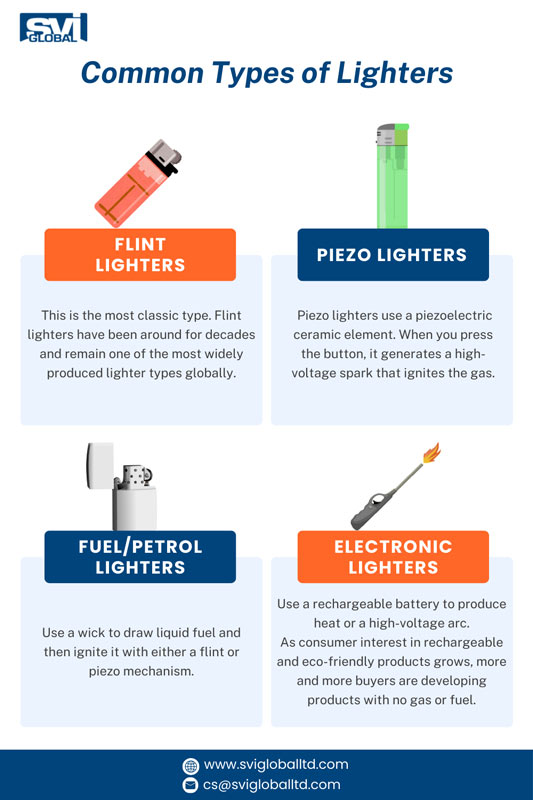
Before you start working with a lighter manufacturer, it helps to have a clear understanding of the different types of lighters available on the market. Generally speaking, lighters can be grouped into four main categories based on their ignition mechanism and energy source.

1) Flint Lighters

This is the most classic type. Flint lighters have been around for decades and remain one of the most widely produced lighter types globally.

🔎 How It Works: A small metal wheel strikes against a flint stone to create a spark, which then ignites the fuel.

📝 Examples: Plastic lighters to vintage-style metal lighters

2) Piezo Lighters

Because there is no flint to wear down, piezo lighters tend to have a longer usable life.

🔎 How It Works: Piezo lighters use a piezoelectric ceramic element. When you press the button, it generates a high-voltage spark that ignites the gas.

📝 Examples: Disposable gas lighters and kitchen stove lighters

3) Fuel/Petrol Lighters

🔎 How It Works: Use a wick to draw liquid fuel and then ignite it with either a flint or piezo mechanism.

📝 Examples: Zippo lighters with a flip-top lid

4) Electronic Lighters

As consumer interest in rechargeable and eco-friendly products grows, more and more buyers are looking for a reliable electric lighter manufacturer to develop products with no gas or fuel.

🔎 How It Works: Use a rechargeable battery to produce heat or a high-voltage arc

📝 Examples: USB charging arc lighters, heated coil lighters

It is worth mentioning that there are also some niche types, such as magnetic induction lighters and microprocessor-controlled lighters. However, these are relatively uncommon in everyday consumer markets.
Key Factors to Consider During Lighter Development

When developing a specific lighter product, there are a few core decisions you need to make early on.

  • Ignition mechanism: whether you want flint, piezo, or electronic (arc, heated coil, etc.).
  • Fuel or energy source: gas, liquid fuel, or a fully battery-powered system.
  • Reusability: Some lighters are designed to be disposable, which is typical for butane lighters. Others can be refilled with gas or fuel, and electronic models can simply be recharged via USB.

Designing for Specific Use Cases

Beyond the basic type, lighters can also be tailored to specific usage scenarios. For example:

  • Windproof lighter / torch lighter: Designed for outdoor use
  • Jet flame lighters: Popular for cigar enthusiasts and outdoor applications.
  • Long-handle gas stove lighters: Built specifically for safely lighting stoves and grills.
  • Pipe lighters: Featured an angled flame designed for the unique shape of a pipe.
Part 2. Materials and Structure of Lighter Manufacturing

The material and internal structure of a lighter directly determine whether the product can pass export safety regulations, and survive durability testing, and avoid leakage complaints.

Many buyers only focus on the appearance and price, neglecting the internal materials and design. This is often the beginning of quality issues.

Common Material Combinations in Lighter Production

1) Plastic Body + Metal Head

This is the most common structure used by a gas lighter manufacturer or butane lighter manufacturer. It uses engineering plastics like POM, standard ABS for housing or functional parts, and metal nozzle and valve components

Suitable for: Disposable and price-driven mainstream products.

✅ Advantages:

  • Low production cost
  • Lightweight
  • Flexible in color and shape
  • Suitable for large-volume export

❎ Risks: The product may fail heat resistance, drop testing, or leakage testing if the factory cuts corners on flame-retardant performance, wall thickness, etc.

2) Full Metal Body + Fuel or Refillable Structure

Common materials include zinc alloy, stainless steel, brass valve, durable sealing rings.

Suitable for: Fuel lighters, mid-to-high-end refillable flint or piezo lighters

✅ Advantages:

  • Higher structural strength
  • Better impact resistance
  • Premium appearance and weight
  • More internal space for windproof or decorative design

❎ Risks: The product may fail quality testing if machining precision is poor or sealing rings and welding quality are weak.

3) Plastic + Metal + Battery Combination

Suitable for: Arc lighters, heating coil lighters, USB rechargeable lighters

✅ Advantages:

  • No gas or fuel required
  • Strong wind resistance
  • Rechargeable
  • Compact structure

❎ Risks: Electronic design requires different expertise compared to traditional products from a fire lighter manufacturer in protection circuit design, heat resistance, etc.

Key Component Materials

The nozzle, valve, springs, seals, flint, piezo ceramic, and electronics in a lighter are small but critical. Their material and precision directly determine the product’s airtightness, ignition reliability, durability, and most importantly, its ability to pass essential safety certifications, as many failures originate here.

Critical Internal Structural Modules

For export lighters, the core of internal structural design is to ensure normal ignition while properly controlling flame height, gas flow, overall airtightness, and meeting child-resistant requirements.

  • Gas Path & Sealing Structure: Proper gas tank design and leak-proof engineering form the physical safety foundation, directly impacting leak tests, temperature rise trials, and transport security.
  • Ignition Mechanism Structure: This governs ignition reliability, child-proof activation, and flame height control.
  • Safety Enhancement Features: Child-resistant locks (CR mechanisms), flame-retardant components, flow interrupters, and overheat protection are essential for regulatory approval. These often invisible “extra structural layers” determine market access success.

Part 3. Compliance and Certifications Required for Lighter Exports

Why Lighters Are Considered High-Compliance Products

Lighters are not ordinary consumer goods. They involve gas, flame, pressure, and in some cases batteries. Because of these risks, most countries treat them as high-regulation products.

Compliance requirements usually focus on safety, child resistance, fire prevention, and explosion risk. The exact rules depend on the importing country, so buyers must always check the specific market regulations before placing orders.

1)Regulatory Requirements in Different Markets

Each market has its own certification system, but the core principle is safety control.

– European Union (EU):

  • CE requirements, EN ISO 9994 safety standard
  • For child safety, EN 13869 specifies testing requirement

– United States (US):

  • Comply with regulations from the Consumer Product Safety Commission (CPSC)
  • Child-resistant device (CR) is mandatory

Other countries may have their own national standards. Requirements vary, so verification should be done case by case.

2)Factory Certifications

Beyond product testing, factory-level certifications are also important. It is better for factories to have these:

  • ISO 9001
  • BSCI / SMETA
  • Safety Production License
  • Recognized Third-Party Testing Institutions, such as SGS, Intertek, and TÜV.

Need Help for Your Sourcing Project?

Let SVI Global find the right suppliers and manage your project.

We guarantee quality and on-time delivery!

Part 4. Key Factors When Choosing a Lighter Factory

1) Product Fit

Before checking certifications or price, first confirm whether the factory is truly suitable for your product.

  • Product category & structure – what percentage does each type represent?
  • Main models – which products ship the most?
  • Customers and channels – online buyers, brands or retailers?

2) Production & Delivery Capability

  • Monthly and yearly output
  • Peak vs off-season capacity
  • Standard lead time
  • Production lines and automation level
  • On-site condition (video or real production photos)

3) R&D and Customization Ability

  • Mold development capability
  • Mold lead time and maintenance ability
  • The engineering team familiar with lighter safety standards
  • Process capability (injection molding, electroplating, printing, etc.)
  • In-house vs stable outsourcing processes

4) Certification and Regulatory Compliance

  • Business license and export registration
  • Dangerous goods production permit (if applicable)
  • ISO 9001 or other management systems
  • Third-party test reports (EN ISO 9994, Child-Resistant tests, etc.)
  • Experience exporting to your target country

5) Quality Control System

  • Incoming material inspection records
  • In-process inspection procedures
  • Final inspection reports
  • AQL sampling standards
  • Lab and testing equipment (leak testing, pressure testing, etc.)

6) Cost Structure and Commercial Terms

Price should be evaluated as part of the overall cooperation structure.

  • Quotation details (tooling cost, unit price, packaging specifications, MOQ)
  • Certification and testing fee allocation
  • Payment terms (deposit, balance, credit period)
  • Lead time commitment and delay liability
  • After-sales responsibility for defective goods
  • Confidentiality agreement to protect intellectual property

Part 5. Challenges in Finding Lighter Manufacturers

Challenges in Lighter Manufacturing

Here are the common pitfalls when sourcing lighter factories, formatted as bullet points:

– Pre-Sourcing Preparation Issues

  • Factories quote inaccurately because you may only have design intent, no internal structure drawings
  • Sudden additional requirements beyond the design draft

– Factory Qualification Issues

  • Factory claims export capability without a valid dangerous goods production license
  • Shows fake, expired, or irrelevant certification certificates
  • Product seized or destroyed at destination port due to missing compliance documentation

– Product Compliance Pitfalls

  • Sample passes tests, but mass production modified to cut costs
  • No Child Safety (CR) testing reports
  • Structure changes trigger re-certification

– Quality Control Failures

  • Inconsistent quality across batches
  • No systematic quality inspections
  • Order outsourced to poor-condition workshops

– Pricing

  • Ultra-low bait pricing initially, then demand increases during contract/production

– Logistics & Packaging Risks

  • Non-compliant packaging causing leakage/explosion during transportation
  • Missing packaging performance tests that may cause customs return
  • Air freight banned, sea freight penalized due to improper goods handling

These traps sound simple, but in actual operation, most of buyers have fallen into them and lost at least one order. Especially for products like lighters that have high regulatory requirements, a small detail can cause the entire container of goods to be scrapped.

How to Find a Reliable Custom Lighter Manufacturer Easily

If you don’t want to fall into these traps yourself or have limited time and energy, finding a professional sourcing agent is the safest choice.

SVI Global is able to:

  • Help you screen out qualified and experienced factories
  • Accompany the factory audit, conduct on-site equipment inspection and testing
  • Follow up on CR testing, type testing, and third-party inspection
  • Total negotiation cost (not only unit price, but also testing/logistics risks)
  • Handle abnormal logistics packaging and customs clearance

Final Thoughts

Choosing the right lighter manufacturer is not just about price or appearance. It’s about understanding materials, internal structure, compliance requirements, and production capability. Whether you are working with a lighter manufacturer in China, a butane lighter manufacturer, or an electric lighter manufacturer, the key is making sure the factory can meet your target market’s safety and certification standards.

Table of contents

Related Blogs
Get in Touch

Send us a message, we’ll get back to you within 24 business hours.

Get a Free Quote Now!

Send us a message, we’ll get back to you within 24 business hours.

Message

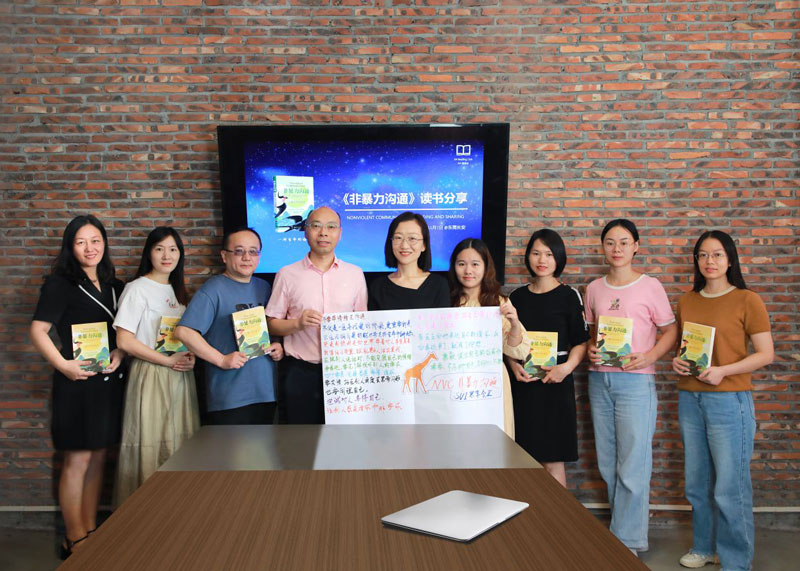
Reading Club

The goal of SVl Reading Club is to READ, THINK, and ENJOY. 

Club members will explore a shared classic book each session. Through individual reading, club discussions and sharing of reading inspirations, members will engage in meaningful and thoughtful exchanges of ideas. Cultivating a reading habit will help to promote cognition, enhance your knowledge, and foster flexible thinking.

reading club